

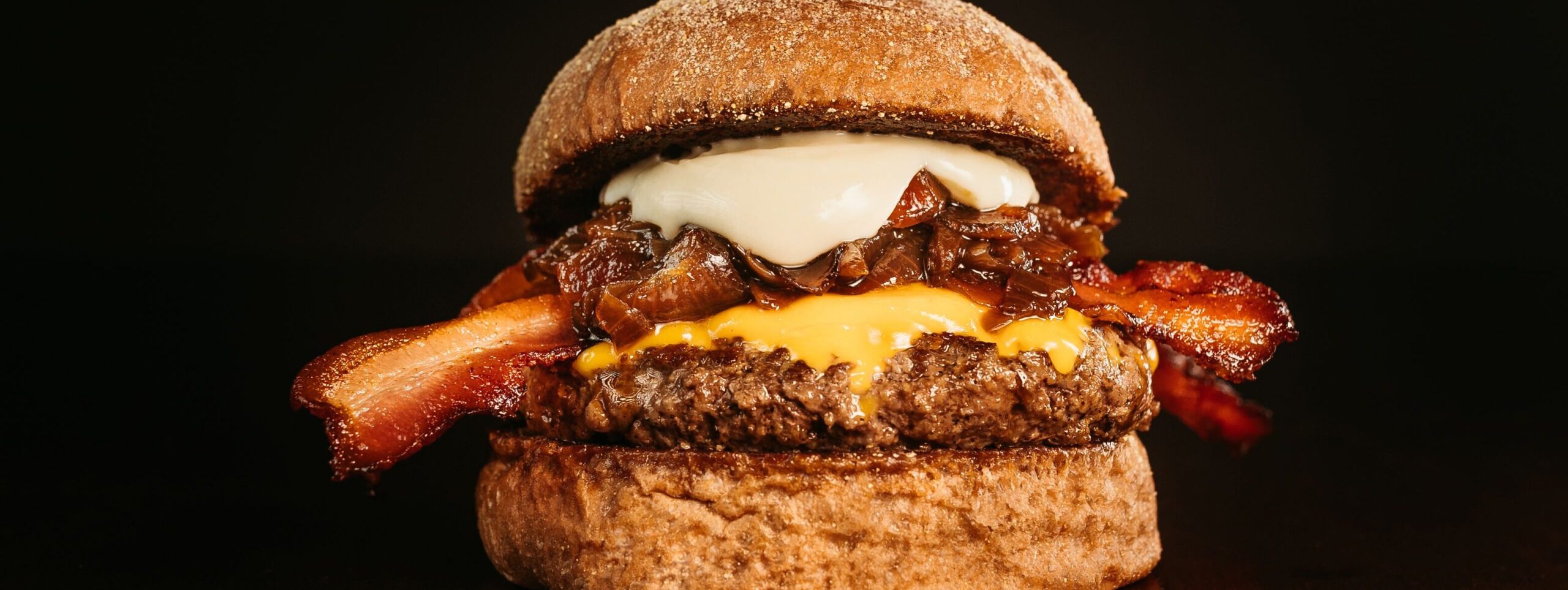
It’s one of the most-asked food questions on the internet, and the setup basically writes itself: you eat a hamburger almost every week, and it has never once contained ham. So what’s actually going on with the name?
Short answer: it’s named after Hamburg, Germany — not because of any ingredient, but because of a beef dish called «Hamburg steak» that came from there. The name part is fairly well settled. What’s genuinely NOT settled is who actually invented the hamburger sandwich as we know it today, and that part turns into a five-way argument nobody has ever fully resolved.
The name: solved, mostly
«Hamburger» is simply the German word for «a person or thing from Hamburg» — the same pattern as calling someone from Berlin a Berliner. It has zero etymological connection to pigs. The dish that earned the name was Hamburg steak: a seasoned, minced beef patty that became associated with the German port city.
One honest caveat worth including: the Online Etymology Dictionary notes the food term shows up around 1880 as «hamburg steak,» named for the city, but adds that «no certain connection has ever been put forth» for exactly how or why that specific naming happened. The city link is essentially agreed on — the precise story of who first made that connection is fuzzier than most food blogs let on.
The legend that might not hold up: raw meat under a saddle
Here’s a popular story you’ll see repeated everywhere: that the dish traces back to Tatar (or Tartar) horsemen from Central Asia, who supposedly tenderized raw meat by placing it under their saddles while riding, later eating it shredded and raw — which some claim eventually evolved into both steak tartare and, down the line, the hamburger.
It’s a vivid image, and it’s repeated constantly. But some food historians consider it a bit of a stretch as an actual documented chain of events, rather than a confirmed historical fact. It’s the kind of origin story that survives because it’s memorable, not necessarily because it’s proven.
The part that’s better documented: Baltic trade and German klopse
A steadier version of the story: in the 1600s, Russian trade ships brought a raw minced beef dish (a relative of what we now know as steak tartare) into the German port of Hamburg. Combined with older German minced-meat traditions — including a medieval dish called klopse — this evolved into Hamburg steak: seasoned ground beef, cooked, no bun involved yet.
By the 1800s, Hamburg steak was popular enough that German emigrants brought the recipe across the Atlantic. It even hit an upscale American menu — New York’s famous Delmonico’s restaurant listed «Hamburg steak» in 1873.
So who actually put it in a bun?
This is where the story stops having one answer at all. At least five different people or places have a serious historical claim to inventing the hamburger sandwich — patty, bun, and all:
- Louis Lassen, at Louis’ Lunch in New Haven, Connecticut, reportedly served a ground beef patty between two slices of bread around 1900 — and the restaurant still stands today, proudly claiming the title.
- Frank and Charles Menches, who allegedly created a beef sandwich at a county fair in Hamburg, New York, in 1885 (a genuinely fun coincidence, given the name).
- Charlie Nagreen, said to have sold a flattened meatball between bread at a Wisconsin county fair, also around 1885.
- Fletcher Davis, credited by some Texas food historians with serving a similar sandwich around the same era.
- Oscar Weber Bilby, said to have served the first hamburger on a bun in Oklahoma in 1891.
Nobody has definitively won this argument, and at this point, probably nobody ever will — the claims are scattered, decades-old, and rely mostly on family and town histories rather than hard documentation. What’s clear is that hamburger sandwiches became a genuine national sensation after the 1904 World’s Fair in St. Louis, where they were sold to massive crowds and helped cement the dish into American food culture for good.
Myth or fact?
Myth: that there’s one clean, agreed-upon answer for who invented the hamburger sandwich. There isn’t — there are at least five competing claims, none conclusively proven over the others.
Fact: the name «hamburger» is solidly traced to Hamburg, Germany, via Hamburg steak — a dish shaped by centuries of European trade and immigration, brought to America by German immigrants, and turned into the bunned sandwich we know today by someone (or several someones) history never quite pinned down.
Sources consulted: Katom «Where Did Hamburgers Originate?»; Reader’s Digest «Why Is It Called a Hamburger If There’s No Ham?»; HowStuffWorks hamburger origin FAQ; Mashed «This Is How Hamburgers Really Got Their Name» (citing Online Etymology Dictionary); Oinos Bistrot hamburger history.