

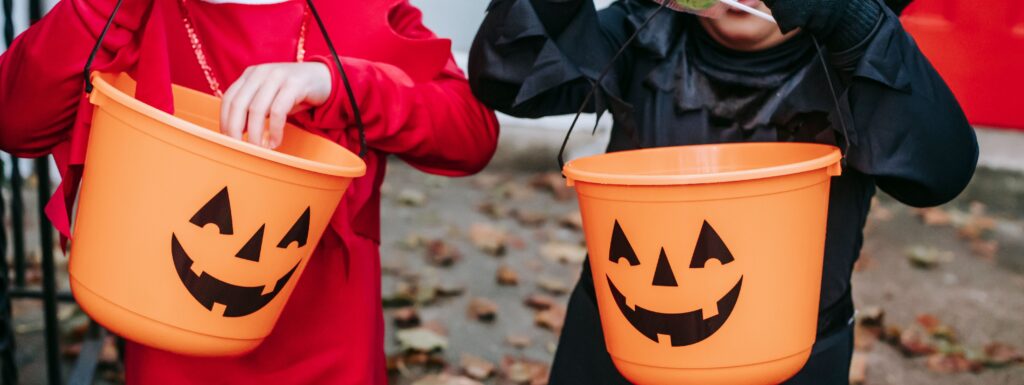
It feels like one of those traditions that must stretch back centuries — kids in costumes, ancient superstition, old-world magic. Here’s the surprise: the specific ritual of knocking on doors and saying «trick or treat» is barely a century old, and the exact phrase has a weirdly precise birthdate.
Short answer: trick-or-treating has real ancient ingredients — Celtic festivals, medieval prayer-for-food customs, costumed door-to-door performances — but the modern version, candy and all, was assembled in early 20th-century North America, largely as a way to stop kids from committing actual property damage.
The real ancient roots (sort of)
The deepest root goes back over 2,000 years to Samhain, a Celtic harvest festival marking the start of the new year. People believed spirits of the dead walked the earth that night, and wore masks or disguises specifically to blend in and avoid being bothered by them — the earliest ancestor of the Halloween costume.
Centuries later, in medieval Britain and Ireland, this evolved into souling: people went door-to-door on All Souls’ Day offering prayers for the dead in exchange for food. A related, more secular custom called guising developed in Scotland and Ireland, first recorded there in the 16th century — kids performing a joke, song, or poem for a reward, rather than offering a prayer.
Here’s the honest caveat worth including: historians are clear that it’s not proven that modern trick-or-treating directly descends from souling or guising in an unbroken line. They’re genuine ancestors in spirit — «give a small performance or gesture, receive food» — but the specific modern ritual was built separately, much later, an ocean away.
So where does «trick or treat» actually come from?
Irish and Scottish immigrants brought guising-style customs to North America through the 1800s. But by the early 20th century, American Halloween had drifted toward something rowdier: destructive pranks. Kids would overturn outhouses, unhinge fence gates, or take apart farm equipment and reassemble it on rooftops. Property owners and lawmakers got fed up, and communities started actively promoting trick-or-treating specifically as a safer, more manageable alternative — essentially bribing kids with treats to redirect them away from vandalism.
The exact phrase «trick or treat» has a surprisingly specific first appearance: a November 1927 article in The Blackie Times, a small newspaper in Blackie, Alberta, Canada. It described local kids demanding treats at doors, phrased essentially as a threat of mischief if refused. One widely cited line from a nearby Alberta paper, the Lethbridge Herald, put it like this that same year: young «tormentors» went door to door demanding «edible plunder,» and homeowners who paid up «sent the robbers away rejoicing.» (One source places an earlier use of the phrase in Ontario in 1917, though this is less consistently cited than the 1927 Alberta references.)
By the 1930s, the phrase and the practice had spread across the U.S. and Canada — still with a genuine «give us a treat or face a prank» edge, not the purely fun, candy-focused version kids do today.
Myth: it’s always been about candy
Even once trick-or-treating caught on, candy wasn’t the automatic go-to treat. Early 20th-century households handed out whatever was on hand — fruit, nuts, homemade taffy, coins. Candy had been a party snack at American Halloween gatherings since the 1800s, but it didn’t become the default door-to-door treat until well into the 20th century.
There’s also a real pause worth knowing about: trick-or-treating in the U.S. was significantly disrupted during World War II because of sugar rationing, which made handing out candy impractical for millions of households. It picked back up after the war ended, right as the postwar baby boom created an enormous new population of trick-or-treating kids — and candy companies were more than happy to market individually wrapped sweets as the easy, no-mess answer for overwhelmed parents. That combination is largely what cemented candy as «the» Halloween treat by the 1950s.
Myth or fact?
Myth: that trick-or-treating is a single, ancient tradition that’s been practiced the same way for centuries, always centered on candy.
Fact: the ingredients are ancient and scattered (Samhain’s costumes, souling’s door-to-door exchange, guising’s performances), but the specific ritual — and the exact phrase «trick or treat» — only crystallized in 1920s Canada, largely as crowd control for destructive pranking, with candy only becoming the standard treat after World War II.
Sources consulted: Mental Floss, «Why Do We Say ‘Trick or Treat’ on Halloween?» and «Why Do We Go Trick-or-Treating on Halloween?»; Britannica, «History of Trick-or-Treating»; National Geographic, «Here’s how trick-or-treating became a Halloween tradition» (citing etymologist Barry Popik); HalloweenCostumes.com blog, «What Is Trick-Or-Treating, and Why Do We Trick-Or-Treat?»